
How to find all procedures having table reference in Sql server
Understanding the Importance of Finding Table References
When managing large databases, it is essential to understand the relationships between different database objects. Stored procedures often rely on specific tables for their operations, making it crucial to identify these dependencies. This understanding can help prevent issues during database modifications, such as altering table structures or optimizing queries.
For instance, if you plan to drop a table or change its schema, knowing which stored procedures rely on it can save you from runtime errors and maintain the integrity of your database operations. Additionally, it aids in performance tuning by allowing you to focus on procedures that have the most significant impact on your data interactions.
Prerequisites
Before you start searching for table references in stored procedures, ensure you have the following:
- Access to SQL Server Management Studio (SSMS): This is the primary tool for managing SQL Server databases.
- Appropriate Permissions: You need sufficient permissions to read system views and execute stored procedures.
Finding Procedures with Table References
To identify stored procedures that reference a specific table, you can use the following SQL query:
SELECT Name FROM sys.procedures WHERE OBJECT_DEFINITION(OBJECT_ID) LIKE '%tblblogs%'This query searches through the definitions of all stored procedures in the database and returns those that include the specified table name, in this case, tblblogs. Make sure to replace tblblogs with the actual table name you are investigating.
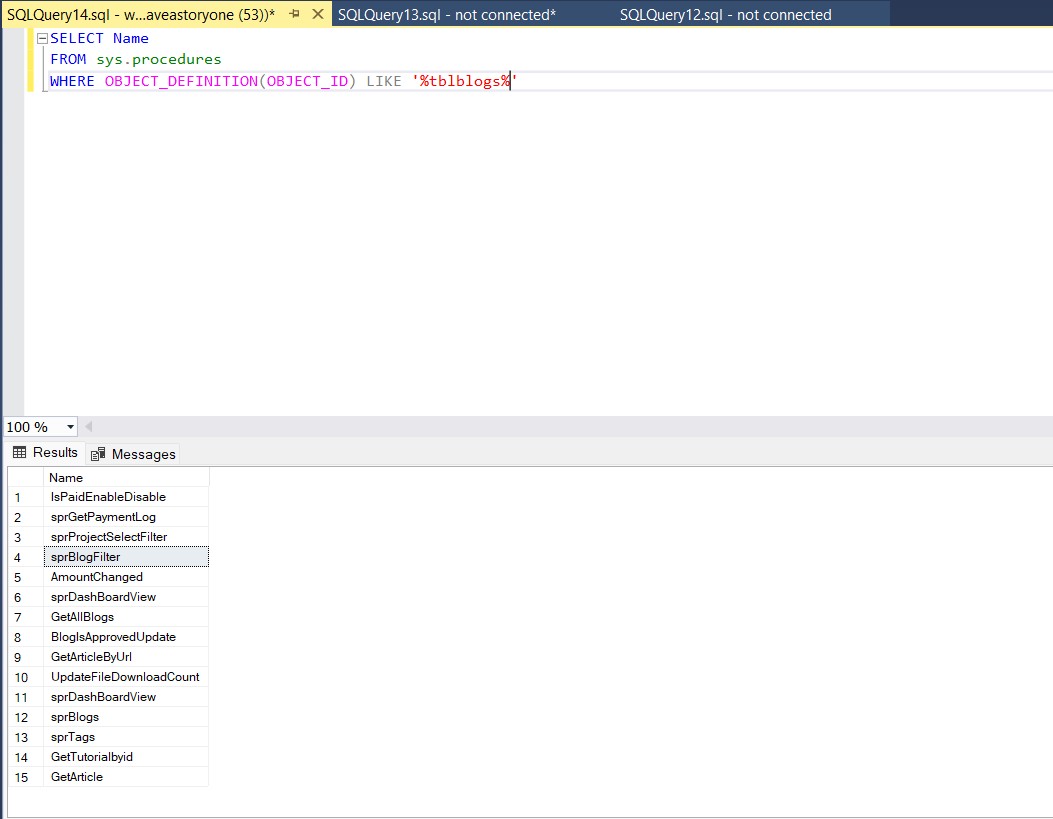
The result will list all procedures where tblblogs is referenced. This is particularly useful during maintenance or when you are looking to optimize query performance.
Advanced Techniques for Searching Table References
While the basic query is effective, you might want to explore more advanced techniques for a comprehensive search. For example, you can search for table references across multiple databases or include additional filters based on schema names.
SELECT p.name AS ProcedureName, s.name AS SchemaName FROM sys.procedures p JOIN sys.schemas s ON p.schema_id = s.schema_id WHERE OBJECT_DEFINITION(p.object_id) LIKE '%tblblogs%'This query provides not only the procedure names but also their respective schema names, which can be helpful in distinguishing procedures with the same name in different schemas.
Using SQL Server Management Studio to Find Table References
In addition to running SQL queries, you can also use SQL Server Management Studio (SSMS) to find stored procedures that reference a specific table through its graphical interface. Right-click on the table in the Object Explorer and select View Dependencies. This will show you all the database objects that depend on the selected table, including stored procedures.
This method is user-friendly and provides a visual representation of dependencies, making it easy to understand the relationships between tables and procedures. However, it may not be as comprehensive as running a direct SQL query, especially in complex databases with numerous dependencies.
Edge Cases & Gotchas
When searching for table references, be aware of potential edge cases:
- Dynamic SQL: If a stored procedure uses dynamic SQL to reference a table, it may not be captured by the standard query. You may need to review the procedure's code manually.
- Commented Code: If table references are commented out, they will not be detected by the query. Ensure you check for commented sections if you suspect references exist.
- Multiple Table Names: If your table name is a substring of other table names, you may get false positives. Use more specific queries or regular expressions to refine your search.
Performance & Best Practices
To optimize your search for table references, consider the following best practices:
- Use Specific Queries: Instead of using broad searches, try to specify the schema or use the full table name to avoid false positives.
- Regular Maintenance: Regularly review stored procedures and their dependencies to keep your database optimized and avoid unexpected issues during changes.
- Document Dependencies: Maintain documentation of table and procedure dependencies to make it easier for team members to understand the database architecture.
Conclusion
Identifying stored procedures that reference specific tables is a crucial task in SQL Server database management. By using the techniques outlined in this article, you can effectively locate these dependencies, ensuring smoother database operations and maintenance.
- Utilize SQL queries to find stored procedures referencing specific tables.
- Explore advanced techniques for comprehensive searches.
- Leverage SQL Server Management Studio for a visual approach.
- Be aware of edge cases and apply best practices for optimal performance.
