
Linked Hashset In Java
LinkedHashSet in Java
LinkedHashSet is a part of the Java Collections Framework and is an implementation of the Set interface. It combines the features of both HashSet and LinkedList. LinkedHashSet maintains a predictable iteration order, which is the order in which elements were inserted into the set. Like HashSet, it does not allow duplicate elements and provides constant-time performance for basic operations.
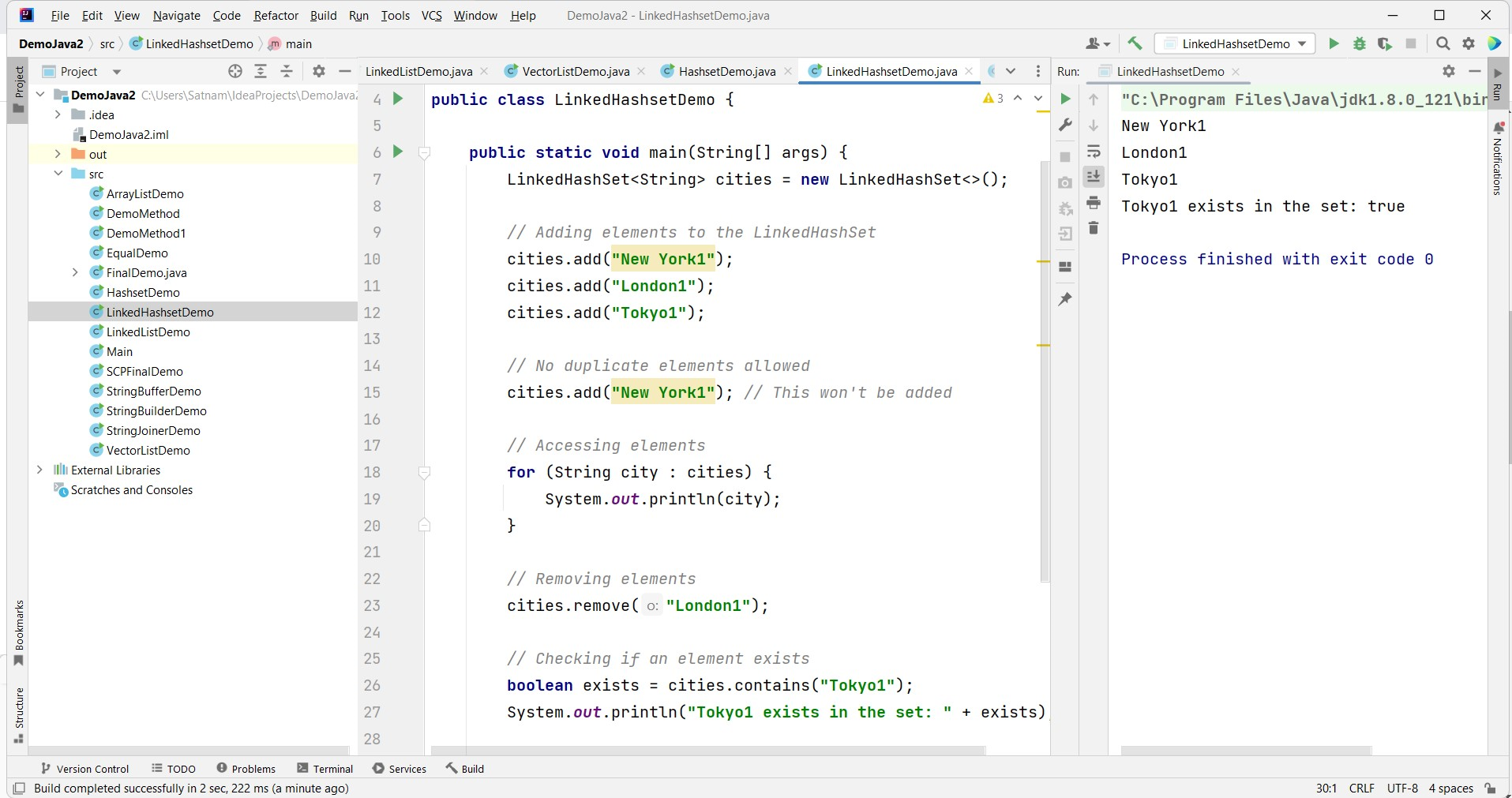
Declaration and Initialization
To use a LinkedHashSet in Java, you need to import the java.util.LinkedHashSet package. Below is an example of declaring and initializing a LinkedHashSet:
import java.util.LinkedHashSet;

public class Example {
    public static void main(String[] args) {
        LinkedHashSet<String> cities = new LinkedHashSet<>();
        // Adding elements to the LinkedHashSet
        cities.add("New York");
        cities.add("London");
        cities.add("Tokyo");
        // No duplicate elements allowed
        cities.add("New York"); // This won't be added
        // Accessing elements
        for (String city : cities) {
            System.out.println(city);
        }
        // Removing elements
        cities.remove("London");
        // Checking if an element exists
        boolean exists = cities.contains("Tokyo");
        System.out.println("Tokyo exists in the set: " + exists);
    }
}
Common LinkedHashSet Operations
Here are some commonly used operations with LinkedHashSets:
- add(element) : Adds an element to the LinkedHashSet.
- remove(element) : Removes an element from the LinkedHashSet.
- contains(element) : Checks if the LinkedHashSet contains a specific element.
- size() : Returns the number of elements in the LinkedHashSet.
- isEmpty() : Checks if the LinkedHashSet is empty.
- clear() : Removes all elements from the LinkedHashSet.
LinkedHashSet is an excellent choice when the requirement is to maintain a unique set of elements with a predictable order of insertion. It provides efficient and predictable performance for most set operations and is widely used in various Java applications.
Real-World Use Cases
LinkedHashSet is particularly useful in scenarios where you need to maintain a collection of unique items while preserving their insertion order. Common use cases include:
- Maintaining a cache: When implementing a caching mechanism, you often want to store unique keys while keeping track of the order they were accessed or added.
- Storing user inputs: In applications that require collecting user inputs without duplicates, such as form submissions or surveys, LinkedHashSet can efficiently manage these entries.
- Order-preserving data structures: Any situation where the order of elements is important can benefit from LinkedHashSet's predictable iteration.
Edge Cases & Gotchas
While LinkedHashSet is a robust data structure, there are some edge cases and gotchas to be aware of:
- Null Elements: LinkedHashSet allows one null element, but be cautious when using nulls as they can lead to unexpected behavior in certain methods.
- Performance Overhead: Although LinkedHashSet provides constant-time performance for basic operations, it does incur some overhead due to maintaining the linked list for iteration order. For large datasets, consider whether this overhead is acceptable.
- Concurrent Modifications: If a LinkedHashSet is modified while iterating over it, it will throw a
ConcurrentModificationException. Always use iterators or synchronized blocks when dealing with concurrent modifications.
Performance & Best Practices
When working with LinkedHashSet, it is essential to follow best practices to ensure optimal performance:
- Initial Capacity: If you know the approximate number of elements to be stored, specify the initial capacity to minimize resizing operations.
- Load Factor: The default load factor is 0.75, which offers a good trade-off between time and space cost. Adjust it only if necessary based on the specific use case.
- Use for Unique Elements: LinkedHashSet is best suited for cases where you need unique elements with predictable order. Avoid using it when the order is not important or when duplicates are allowed.
- Thread Safety: If you need a thread-safe version, consider using
Collections.synchronizedSet(new LinkedHashSet<>())or alternatives from thejava.util.concurrentpackage.
Conclusion
LinkedHashSet is a powerful and versatile data structure in Java that combines the best features of HashSet and LinkedList. It is particularly valuable in scenarios where both uniqueness and order matter. Here are some key takeaways:
- Maintains insertion order while disallowing duplicates.
- Offers constant-time performance for basic operations.
- Useful in real-world scenarios such as caching and user input storage.
- Be aware of edge cases like null elements and concurrent modifications.
- Follow best practices for performance optimization.
