
Get SMS Logs from Twillio in Asp.Net MVC
Overview of Twilio SMS Logs
Twilio SMS logs are invaluable for tracking the status and history of messages sent through the Twilio API. Understanding these logs helps developers monitor message delivery, troubleshoot issues, and analyze communication patterns. In this tutorial, we will delve into the steps required to retrieve SMS logs from Twilio in an ASP.NET MVC application.
By accessing SMS logs, businesses can gain insights into customer interactions, assess the effectiveness of marketing campaigns, and ensure compliance with messaging regulations. Whether you are building a notification system or a marketing tool, having access to SMS logs is crucial for maintaining a successful communication strategy.
Prerequisites
Before we begin, ensure you have the following prerequisites:
- Visual Studio: A development environment to create and manage your ASP.NET MVC project.
- Twilio Account: Sign up for a Twilio account and obtain your Account SID and Auth Token from the Twilio dashboard.
- Basic Knowledge of ASP.NET MVC: Familiarity with MVC architecture and C# programming will be helpful.
Installing the Twilio NuGet Package
To interact with the Twilio API, you need to install the Twilio NuGet package. This package provides the necessary libraries to easily send and receive SMS messages.
NuGet\Install-Package Twilio.AspNet.Mvc -Version 6.0.0After installing the package, you can verify it in the "Dependencies" section of your project. This package will facilitate the API calls needed to retrieve SMS logs.
Configuring Your Application
Next, you will need to configure your application to connect to the Twilio API. This involves adding your Account SID and Auth Token to the web.config file. Open the web.config file and add the following entries:
<appSettings>
  <add key="config:AccountSid" value="AC3936d9aqq2323fedbdddd0ecd6df37199" />  <!--Replace with your AccountSid-->
  <add key="config:AuthToken" value="52b86f79c19bsassasasas704110dddddc26" />  <!--Replace with your AuthToken-->
</appSettings>
Make sure to replace the placeholder values with your actual Twilio credentials. This configuration enables your application to authenticate with Twilio and access its services.
Creating the SMS Controller
Now, let's create a controller that will handle requests related to SMS logs. In the Controllers folder, create a new class named SmsController. This controller will initialize the Twilio client and retrieve the SMS logs.
using System;
using System.Configuration;
using System.Linq;
using System.Web.Mvc;
using Twilio;
using Twilio.Rest.Api.V2010.Account;

namespace TwillioMVC.Controllers {
  public class SmsController : Controller {
    // GET: Sms
    public ActionResult Index() {
      string accountSid = Convert.ToString(ConfigurationManager.AppSettings["config:AccountSid"]);
      string authToken = Convert.ToString(ConfigurationManager.AppSettings["config:AuthToken"]);
      TwilioClient.Init(accountSid, authToken);
      var messages = MessageResource.Read().ToList();
      return View(messages);
    }
  }
}
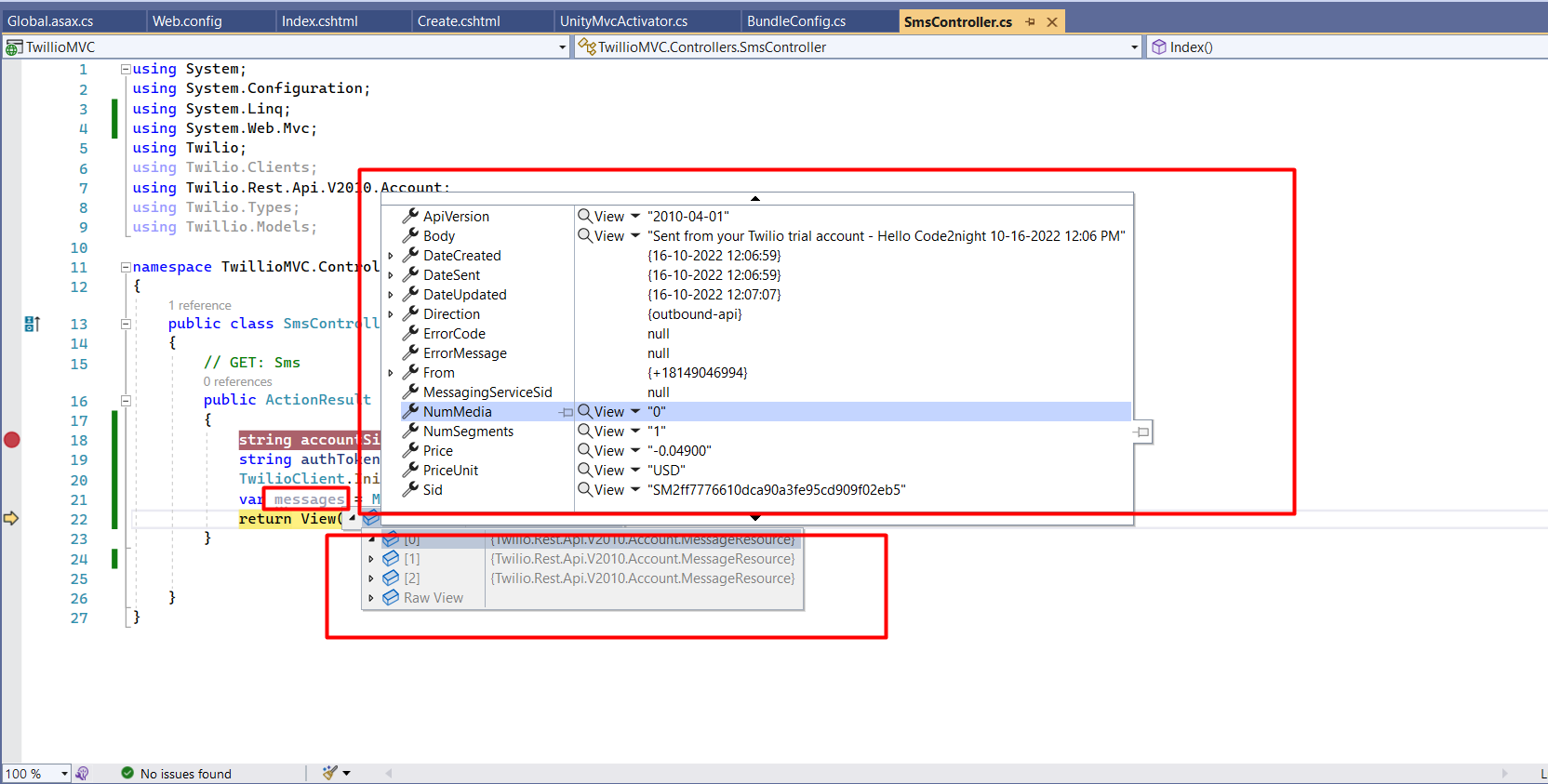
In this code, we initialize the Twilio client with the credentials stored in the configuration file. We then call MessageResource.Read() to fetch the list of sent messages and return it to the view.
Displaying SMS Logs in the View
To display the SMS logs, you will need to create a view for the Index action in your SmsController. Create a new view named Index.cshtml in the Views/Sms folder. Here is an example of how to display the SMS logs:
@model IEnumerable<Twilio.Rest.Api.V2010.Account.MessageResource>

<h2>SMS Logs</h2>
<table>
  <tr>
    <th>Date Sent</th>
    <th>To</th>
    <th>From</th>
    <th>Body</th>
  </tr>
  @foreach (var message in Model) {
    <tr>
      <td>@message.DateSent</td>
      <td>@message.To</td>
      <td>@message.From</td>
      <td>@message.Body</td>
    </tr>
  }
</table>
This view iterates through the list of messages and displays the date sent, recipient, sender, and message body in a table format. You can customize the layout and styling as needed.
Edge Cases & Gotchas
While working with the Twilio API, developers may encounter several edge cases and gotchas. Here are a few to keep in mind:
- Rate Limits: Twilio imposes rate limits on API requests. If you exceed these limits, you may receive errors. It’s essential to handle such errors gracefully in your application.
- Message Status: Not all messages sent through Twilio are guaranteed to be delivered. Be sure to check the message status in the logs to understand delivery issues.
- Data Privacy: Always ensure that you comply with data privacy regulations when handling user data. Store only necessary information and anonymize sensitive data.
- Time Zones: SMS logs are timestamped in UTC. Be cautious when displaying dates and times to users in their local time zones.
Performance & Best Practices
To ensure optimal performance and maintainability of your application, consider the following best practices when working with Twilio SMS logs:
- Pagination: If your application sends a large volume of SMS messages, implement pagination when retrieving logs to avoid loading excessive data at once.
- Error Handling: Implement robust error handling to manage API request failures. Use try-catch blocks and log errors for further analysis.
- Environment Variables: Instead of hardcoding your Twilio credentials in the web.config file, consider using environment variables for better security.
- Throttling Requests: When making multiple requests to the Twilio API, implement throttling to stay within rate limits and prevent service disruptions.
Conclusion
In this tutorial, we have explored how to retrieve SMS logs from Twilio in an ASP.NET MVC application. By following the steps outlined, you can effectively monitor and analyze your SMS communications. Here are the key takeaways:
- Integrating Twilio SMS functionality into your application enhances communication capabilities.
- Accessing SMS logs allows for better tracking and troubleshooting of message delivery.
- Always handle edge cases, such as rate limits and message statuses, to ensure a smooth user experience.
- Implement best practices to maintain performance and security in your application.
